วันเสาร์ที่ 28 มีนาคม พ.ศ. 2558

Cambodia profile - Timeline

A chronology of key events


  1. 1863 - Cambodia becomes a protectorate of France. French colonial rule lasts for 90 years.

  1. 1941 - Prince Norodom Sihanouk becomes king. Cambodia is occupied by Japan during World War II.
  2. 1945 - The Japanese occupation ends.
  3. 1946 - France re-imposes its protectorate. A new constitution permits Cambodians to form political parties. Communist guerrillas begin an armed campaign against the French.
  4. Independence
  5. 1953 - Cambodia wins its independence from France. Under King Sihanouk, it becomes the Kingdom of Cambodia.
  6. 1955 - Sihanouk abdicates to pursue a political career. His father becomes king and Sihanouk becomes prime minister.
  7. 1960 - Sihanouk's father dies. Sihanouk becomes head of state.
  8. 1965 - Sihanouk breaks off relations with the US and allows North Vietnamese guerrillas to set up bases in Cambodia in pursuance of their campaign against the US-backed government in South Vietnam.
  9. 1969 - The US begins a secret bombing campaign against North Vietnamese forces on Cambodian soil.


  • 1970 - Prime Minister Lon Nol overthrows Sihanouk in coup. He proclaims the Khmer Republic and sends the army to fight the North Vietnamese in Cambodia. Sihanouk - in exile in China - forms a guerrilla movement. Over next few years the Cambodian army loses territory against the North Vietnamese and communist Khmer Rouge guerrillas
  • Cambodia Year Zero
  • 1975 - Lon Nol is overthrown as the Khmer Rouge led by Pol Pot occupy Phnom Penh. Sihanouk briefly becomes head of state, the country is re-named Kampuchea.
  • All city dwellers are forcibly moved to the countryside to become agricultural workers. Money becomes worthless, basic freedoms are curtailed and religion is banned. The Khmer Rouge coin the phrase "Year Zero".
  • Hundreds of thousands of the educated middle-classes are tortured and executed in special centres. Others starve, or die from disease or exhaustion. The total death toll during the next three years is estimated to be at least 1.7 million.
  • 1976 - The country is re-named Democratic Kampuchea. Sihanouk resigns, Khieu Samphan becomes head of state, Pol Pot is prime minister.
  • 1977 - Fighting breaks out with Vietnam.
  • 1978 - Vietnamese forces invade in a lightning assault.
  • 1979 January - The Vietnamese take Phnom Penh. Pol Pot and Khmer Rouge forces flee to the border region with Thailand.
  • The People's Republic of Kampuchea is established. Many elements of life before the Khmer Rouge take-over are re-established.
  • 1981 - The pro-Vietnamese Kampuchean People's Revolutionary Party wins parliamentary elections. The international community refuses to recognise the new government.
  • The government-in-exile, which includes the Khmer Rouge and Sihanouk, retains its seat at the United Nations.
  • 1985 - Hun Sen becomes prime minister. Cambodia is plagued by guerrilla warfare. Hundreds of thousands become refugees.
  • 1989 - Vietnamese troops withdraw. Hun Sen tries to attract foreign investment by abandoning socialism. The country is re-named the State of Cambodia. Buddhism is re-established as the state religion.

  • An uneasy peace
  • 1991 - A peace agreement is signed in Paris. A UN transitional authority shares power temporarily with representatives of the various factions in Cambodia. Sihanouk becomes head of state. 


Coup
  • 1997 - Hun Sen mounts a coup against the prime minister, Prince Ranariddh, and replaces him with Ung Huot. The coup attracts international condemnation. The Khmer Rouge put Pol Pot on trial and sentence him to life imprisonment.


  • 1998 - Prince Ranariddh is tried in his absence and found guilty of arms smuggling, but is then pardoned by the king.
  • 1998 April - Pol Pot dies in his jungle hideout.
  • 1998 July - Elections are won by Hun Sen's CPP, amid allegations of harassment. A coalition is formed between the CPP and Funcinpec. Hun Sen becomes prime minister, Ranariddh is president of the National Assembly.
  • 2001 - A law setting up a tribunal to bring genocide charges against Khmer Rouge leaders is passed. International donors, encouraged by reform efforts, pledge $560 million in aid.
  • 2001 June - US-based Cambodian Freedom Fighters (CFF) members convicted of 2000 attack in Phnom Penh. Group pledges to continue campaign to overthrow Hun Sen.
  • 2001 December - First bridge across the Mekong River opens, linking east and west Cambodia.
  • 2002 -First multi-party local elections; ruling Cambodian People's Party wins in all but 23 out of 1,620 communes. Ranariddh's half-brother Prince Norodom Chakrapong sets up his own Norodom Chakrapong Khmer Soul Party.
  • 2003 - Serious diplomatic upset with Thailand over comments attributed to a Thai TV star that the Angkor Wat temple complex was stolen from Thailand. Angry crowds attack the Thai embassy in Phnom Penh. Hun Sen's Cambodian People's Party wins general elections but fails to secure sufficient majority to govern alone.
  • Hun Sen re-elected
  • 2004 - After nearly a year of political deadlock, Prime Minister Hun Sen is re-elected after CPP strikes a deal with the royalist Funcinpec party. Parliament ratifies kingdom's entry into World Trade Organisation (WTO). King Sihanouk abdicates and is succeeded by his son Norodom Sihamoni.
  • 2005 February - Opposition leader Sam Rainsy goes abroad after parliament strips him of immunity from prosecution, leaving him open to defamation charges brought by the ruling coalition.
  • 2005 April - Tribunal to try Khmer Rouge leaders gets green light from UN after years of debate about funding.
  • 2005 December - Rainsy is convicted in absentia of defaming Hun Sen and is sentenced to 18 months in prison
  • 2006 February - Rainsy receives a royal pardon and returns home.
  • 2006 May - Parliament votes to abolish prison terms for defamation.
  • 2006 July - Ta Mok, one of the top leaders of the Khmer Rouge regime, dies aged 80.
  • 2006 November - Funcinpec party, a junior partner in the ruling coalition, drops Prince Norodom Ranariddh as its leader.
  • Khmer Rouge trials
  • 2007 March - Ranariddh is sentenced in absentia to 18 months in prison for selling the Funcinpec party's headquarters - a charge he denies.
  • 2007 July - UN-backed tribunals begin questioning Khmer Rouge suspects about allegations of genocide.
  • 2007 September - Most senior surviving Khmer Rouge member, Nuon Chea - "Brother Number Two" - is arrested and charged with crimes against humanity.
  • 2008 April - US court convicts CFF leader Chhun Yasith of masterminding 2000 attack in Phnom Penh.
  •  
  • 2008 July - Hun Sen's ruling CPP claims victory in parliamentary elections criticised by EU monitors. Cambodia and Thailand move troops to disputed land near Preah Vihear temple after decision to list it as UN World Heritage Site fans nationalist sentiment on both sides.
  • 2008 October - Two Cambodian soldiers die in an exchange of fire with Thai troops in the disputed area. Thai soldier dies later of wounds.
  • New spat with Thailand
  • 2009 - Former Khmer Rouge leader Kaing Guek Eav known as Duch goes on trial on charges of presiding over the murder and torture of thousands of people as head of the notorious Tuol Sleng prison camp.
  • Parliament again strips opposition leader Sam Rainsy of immunity. He is charged but fails to appear in court.
  • Another row with Thailand, after Cambodia refuses to extradite ex-Thai prime minister Thaksin Shinawatra and appoints him as an economic adviser instead.
  • 2010 - Comrade Duch is found guilty of crimes against humanity and given 35-year prison sentence.
  • Diplomatic ties with Thailand resumed after Cambodian government announces resignation of Thaksin Shinawatra.
  • Exiled opposition leader Sam Rainsy is sentenced in absentia to 10 years in jail after being found guilty of manipulating a map to suggest Cambodia is losing land to Vietnam.
  • 2011 - Tensions rise as Cambodia charges two Thai citizens with spying after they were arrested for crossing the disputed border. Respective forces exchange fire across the border. Hun Sen calls for UN peacekeepers.


  • Three most senior surviving Khmer Rouge members, including leader Pol Pot's right-hand man, "Brother Number Two" Nuon Chea, go on trial on charges of genocide and crimes against humanity.
  • Cambodia and Thailand agree to withdraw troops from disputed area.
  • 2012 February - Duch loses appeal against conviction at UN-backed tribunal and has sentence increased to life.
  • 2012 March - A second judge quits the tribunal. Swiss Judge Laurent Kasper-Ansermet says going because his Cambodian counterpart, You Bunleng, had thwarted attempts to investigate some former members of the Khmer Rouge regime.
  • 2012 April - Outspoken environmental activist Chut Wutty is shot dead in a confrontation with police while travelling in a threatened forest region in the south-west.
  • 2012 May - Government suspends the granting of land for development by private companies in a bid to curb evictions and illegal logging.
  • Border tension eases
  • 2012 July - Cambodia and Thailand withdraw their troops from a disputed border area near the Preah Vihear temple in line with a ruling by the International Court of Justice which aims to halt outbreaks of armed conflict in recent years.


  • 2012 October - Former king, Norodom Sihanouk, dies of a heart attack. He was 89.
  • 2012 November - Government approves the controversial Lower Sesan 2 hydroelectric dam project on a tributary of the Mekong.
  • 2013 February - Tens of thousands of people turn out in Phnom Penh for the cremation of the former king, Norodom Sihanouk.
  • 2013 March - Former Khmer Rouge foreign minister Ieng Sary dies while awaiting trial for genocide, leaving only Nuon Chea and Khieu Samphan among prominent Khmer Rouge figures still alive and under arrest by the UN-backed tribunal.
  • 2013 June - Parliament passes a bill making it illegal to deny that atrocities were committed by the Khmer Rouge in the 1970s.
  • 2013 July - Opposition leader Sam Rainsy returns from exile.
  • Parliamentary elections. Ruling party of premier Hun Sen claims victory, opposition alleges widespread irregularities.
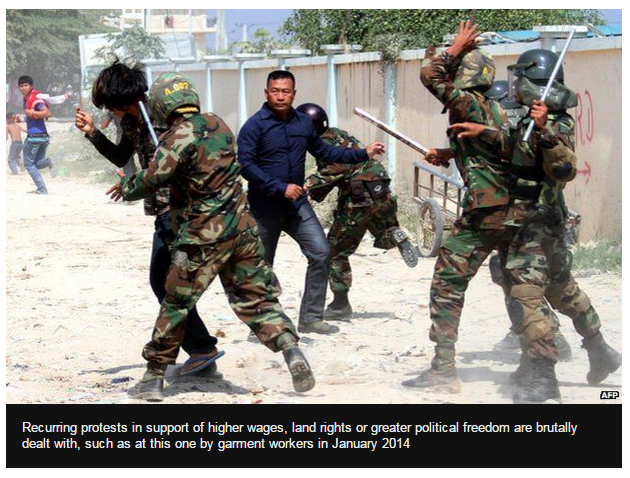
  • 2013 September - Mass protests in Phnom Penh over contested election results. Parliament approves new five-year term for Hun Sen. Opposition boycotts opening of parliament.
  • 2014 January - Riot police clear a two-week opposition protest camp held in Phnom Penh as part of a long-running campaign launched against the government after the disputed 2013 election.
  • 2014 July - More than 150,000 Cambodian workers return home from neighbouring Thailand after rumours circulate that the new military junta there will crack down on illegal migrants.
  • Opposition Cambodia National Rescue Party (CNRP) agrees to end its year-long boycott of parliament as part of an agreement with Prime Minister Hun Sen to break the deadlock over the disputed 2013 parliamentary election.
  • 2014 August - A UN-backed court in Cambodia sentences two senior Khmer Rouge leaders to life in prison for their role in the terror that swept the country in the 1970s. The two, second-in-command Nuon Chea, and the former head of state Khieu Samphan, are the first top Khmer Rouge figures to be jailed.
  • 2015 January - Prime Minister Hun Sen marks thirty years in power.

Thanks BBC


What drives people to murder-suicide?

  • The question has been raised - is 27-year-old Andreas Lubitz a mass murderer for bringing down a plane full of passengers, killing everyone on board?
  • Reports of a "mass murder" investigation in France and pictures of German policemen carting bags of evidence from his parents' home suggest that officials are determined to find out.
 
  • But this appears to be a case of murder-suicide, which is very different and extremely rare.
  • In these incidents, one person wishing to end their life takes the lives of others - in this case, complete strangers - at the same time.
  • The statistics show that most murder-suicides happen in domestic settings, and involve a man and his spouse. 
  •  
  • What drives people to these acts is therefore virtually impossible to determine because there is no common theme and the perpetrators don't leave notes explaining their actions.
  • In contrast to the motivations of a suicide bomber, which are intentionally well-publicised, those behind a murder-suicide are usually more difficult to fathom.
  • No-one, of course, can pretend to know what was in Lubitz's mind as he locked the cockpit door and instigated the plane's devastating descent.
  • 'Inexplicable'
  • Simon Wessely, president of the Royal College of Psychiatrists, says it's unlikely we will ever know.
  • "It's possible something will emerge, but in most suicides people leave clues or a message.
  • "Incredibly extreme events like this are sometimes just inexplicable."
  • Despite this, the media has been quick to point the finger at Lubitz's history of depression.
  • German newspapers have also reported that he had received psychiatric treatment and may have been experiencing a "personal life crisis".
  • In reality, there is a multitude of factors, feelings and personality traits which could push someone to such an extreme course of action.
  • Alcohol problems, drug misuse, broken relationships or marriages, personality disorders, work stresses - in the past or at the time of the act - can all play a part.
  • Mental health charities agree, and have been queuing up to plead for more understanding about depression, and less sensationalist language.
  • They say the vast majority of people with depression do not hurt anyone, and research shows that their risk is primarily to themselves.
  • Stigma danger
  • Marjorie Wallace, chief executive of mental health charity Sane, says: "There are thousands of people with a diagnosis of depression, including pilots, who work, hold positions of high responsibility and who present no danger whatsoever.
  • "We do not know what part depression played in this tragedy but it is a condition that should never be trivialised."
  • Charities said there was a danger that mental health problems could be stigmatised by coverage of the crash, making people more afraid to talk about their experiences.
  • Dr Paul Keedwell, consultant psychiatrist and specialist in mood disorders, also says mental health problems are not a sufficient explanation for what happened.
  • "Among cases of murder-suicide in general, the rate of previously diagnosed depression varies from 40% to 60%, depending on the context."
  • But he does say that of those who are depressed, very few are being treated for it.
  • It is clear that men find it particularly difficult to seek help if they have a history of mental illness.
  • In the UK, for example, 75% of suicides are in men.
  • Lubitz passed the tests set by his employer which indicated he was fit to fly, but it has since come to light that he may have been hiding an illness from them.
  • This illness and his seeming inability to talk about it or come to terms with it may hold some small clue to his actions.
  • But, in reality, there is never going to be an adequate explanation for murder-suicides - particularly for the families of those killed.

Thanks BBC

Alps Germanwings crash co-pilot Lubitz 'made prediction'

  • The Germanwings co-pilot thought to have deliberately crashed his Airbus in the French Alps, killing 150 people, predicted "one day everyone will know my name", his ex-girlfriend says.


http://newsth1.blogspot.com/

  • In an interview with Germany's Bild newspaper, she recalled a comment Andreas Lubitz made last year.
  • "One day I'm going to do something that will change the whole system, and everyone will know my name and remember," he told her.
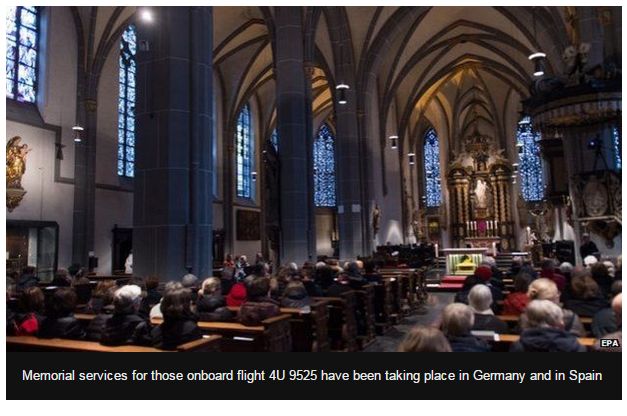
  • Flight 4U 9525 crashed on Tuesday.
  • The woman, a 26-year-old flight attendant who flew with Mr Lubitz for five months last year, was "very shocked" when she heard the news, the papers says.
  • If Mr Lubitz deliberately brought down the plane, "it is because he understood that because of his health problems, his big dream of a job at Lufthansa, as captain and as a long-haul pilot was practically impossible," she told Bild.
  • The black box voice recorder indicates that Mr Lubitz locked his captain out of the cockpit on Tuesday and crashed the plane into a mountainside in what appears to have been a suicide and mass killing.
  • German prosecutors say they found medical documents at Mr Lubitz's house suggesting an existing illness and evidence of medical treatment. They found torn-up sick notes, one of them for the day of the crash.
  • They say he seems to have concealed his illness from his employers.
  • His former girlfriend told Bild they separated, "because it became increasingly clear that he had a problem".
  • She said he was plagued by nightmares and would at times wake up screaming "we're going down".

  • A hospital in the German city of Duesseldorf has confirmed Mr Lubitz was a patient there recently but it denied media reports that he had been treated for depression.
  • The theory that a mental illness such as depression had affected the co-pilot was suggested by German media, quoting internal aviation authority documents.
  • They said he had suffered a serious depressive episode while training in 2009.

  •  He reportedly went on to receive treatment for a year and a half and was recommended regular psychological assessment.
  • Mr Lubitz's employers insisted that he had only been allowed to resume training after his suitability was "re-established".
  • French police say the search for passenger remains and debris on the mountain slopes could take another two weeks.
  • In the aftermath of the crash, the EU's aviation regulator, the European Aviation Safety Agency, has urged airlines to adopt new safety rules.
  • In future, it says, two crew members should be present in the cockpit at all times.


Thanks BBC


Cambodian History

  • No one knows for certain how long people have lived in what is now Cambodia, as studies of its prehistory are undeveloped. A carbon-l4 dating from a cave in northwestern Cambodia suggests that people using stone tools lived in the cave as early as 4000 bc, and rice has been grown on Cambodian soil since well before the 1st century ad. The first Cambodians likely arrived long before either of these dates. They probably migrated from the north, although nothing is known about their language or their way of life.

  • By the beginning of the 1st century ad, Chinese traders began to report the existence of inland and coastal kingdoms in Cambodia. These kingdoms already owed much to Indian culture, which provided alphabets, art forms, architectural styles, religions (Hinduism and Buddhism), and a stratified class system. Local beliefs that stressed the importance of ancestral spirits coexisted with the Indian religions and remain powerful today.


Please Helping Poor People From Cambodia 


  • Bayon Temple, Angkor Thom The giant faces carved on the Bayon temple at the Angkor Thum complex in northwestern Cambodia represent both the Buddha and King Jayavarman VII (ruled about 1130-1219). Although a Buddhist temple, Angkor Thum was modeled after the great Hindu temple complex of Angkor Wat.

  • In the early 9th century a Khmer (ethnic Cambodian) prince returned to Cambodia from abroad. He probably arrived from nearby Java or Sumatra, where he may have been held hostage by island kings who had asserted control over portions of the Southeast Asian mainland.


Cambodia Food is Very Cheap

  • Water, rice and freshwater fish exert the most profound influences on Khmer cuisine. The Mekong river, the twelfth longest in the world cuts through the very heart of Cambodia. The capital Phnom Penh is on its riverbank, at the junction where two other rivers meet: the Tonle Sap and Bassac. The Tonle

  • Sap river connects the Mekong with the Tonle Sap lake, or Great Lake, which acts as a liquid heart and natural reservoir for the entire Mekong river system, regulating the flow of huge volumes of water, and allowing the safe passage of an astonishing number of freshwater fish. The lake itself is believed to have more fish than any other in the world and ranks second only to the Amazon river in biodiversity.[citation needed]


  • When the rainy season begins at the start of the Khmer New Year, the region becomes inundated with monsoonal rain and Cambodia turns into a vast ocean of emerald rice-paddies. The geographical setting of wetlands (Cambodia ranks second to Bangladesh for the most amount of wetland in Asia) and floodplains explains why water, and hence fish and rice (which grow in water) are such an integral component to the cuisine. Many dishes, in particular the samlors, have a pond-like appearance, and are often loaded with reed-like plants, leaves and vegetables, mirroring the surrounding landscape. Dipping sauces tend to be quite watery, as are most Cambodian curries.[citation needed]


  • In 2013 Khmer cuisine shares many commonalities with the food of neighboring Thailand—although, less chilli, sugar and coconut cream are used for flavor—and of neighboring Vietnam, with which it shares and adopts many common dishes, as well as a colonial history, as both formed part of the French colonial empire in Southeast Asia. It has drawn upon influences from the cuisines of China and France, powerful players in Cambodian history. The Chinese began arriving in the 13th century, but Chinese migration accelerated during the French period. Curry dishes, known as kari (in Khmer, ការី) show a trace of cultural influence from India. The many variations of rice noodles show the influences from Chinese cuisine. Preserved lemons are another unusual ingredient not commonly found in the cooking of Cambodia's neighbours; it is used in some Khmer dishes to enhance the sourness. The Portuguese and Spanish also had considerable influence in Cambodian affairs in the 16th century, introducing chilli and peanuts into Asia from the New World. However, chilli never gained the same status or prominence as it did with the cuisines of neighboring Thailand, Laos and Malaysia. Even today very few recipes include chilli.


  • One legacy of French, the baguette - known as nom pang in Khmer - is ubiquitous in all parts of Cambodia today. Ironically, as dependent as Cambodia is on rice for food and its identity, Cambodians are also said to eat more bread than any other people in Asia. Cambodians often eat bread with pâté, tinned sardines or eggs. One of these with a cup of strong coffee, sweetened with condensed milk, is an example of a common Cambodian breakfast. Freshly buttered baguettes can be made into sandwiches (also called nom pang) and may be stuffed with slices of ham or any number of grilled meats, with Kampot pepper, similar to Vietnamese banh mi. The French also introduced beer, butter, pate, coffee, chocolate, onions, carrots, broccoli, potatoes and many other types of non-native produce to Southeast Asia.

  • Traditionally, Cambodians eat their meals with at least three or four dishes. A meal will usually include a soup, or samlor, served alongside the main courses. Each individual dish will be either sweet, sour, salty or bitter in taste. Chilli (fresh, pickled or dried) and chilli sauce is served on the side and left up to individual diners and to their taste. In this way Cambodians ensure that they get a bit of every flavor to satisfy their palates.


Rattanakiri - Cambodia


  • I. Background

  • Province Capital: 636 km. north - east of Phnom Penh
  • Area: 11,052 Square kilometers
  • Population: 94243 people (ethnic minority) represent 75.77% of the total.
  • Religion: Buddhism and Animism.
  • Accessibility: by land, car from Phnom Penh/Kratie/Steung Treng to Rattanakiri.
  • Major occupations: farming
  • Major products: gemstones & agriculture
  • Major industries: farming & tourism 


Ratanakiri became a province of Kingdom of Cambodia in 1960

 under King Norodom Sihanouk's reign. Banlung is the capital city of Ratanakiri, situated in the highland, along the National Road No19 from Ou porng Moan to the Vietnam border about 200 km. ( Ou´ porng Moan-Banlung is about 120km, Banlung-Vietnam 80k.m)

Ratanakiri is situated on the north - east plateau , 636 Km from Phnom Penh. It is bordering Vietnam on the east, Laos PDR on the North, Steung Treng on the West and Mondul Kiri on the South. There are two rivers crossing the province ( Sre Pork and Sresan River )

A sparsely populated province, it is renowned for its unique natural beauty and wealth of natural resources. The physical and environmental characteristic of the province forms an impressive range including undulating hills and mountains, a level plateau, watershed lowlands, crater lakes, rivers and waterfalls. Forest cover varies from area to area, from the dense impenetrable forest in the northern reaches, which are still rich in wildlife, to the drier and sparser forest, found in the southwest. Similarly, the soil types present range from rich volcanic soil to the sandy soil found near rivers.Thus Ratanakiri province offers wonderful opportunities for Eco-tourism in Cambodia.